
Test: Angel or Devil
Sopelus StudioTrivia
4.0912.00 Reviews
- Version
- 3.12
- Installs
- 1.00M
- Age Rating
- Everyone
Screenshots

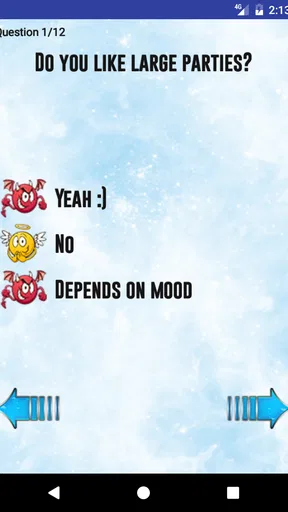
Our Review of Test: Angel or Devil
 Analysis by Appyee
I tried Test: Angel or Devil as a quick personality-style trivia game, and its appeal is easy to understand: it turns a playful question about your character into a short, low-pressure activity. The basic idea is to see whether your answers lean more toward an “angel” or a “devil,” but the real value is less about receiving a serious verdict and more about giving people something amusing to discuss.
That makes it especially suitable for a shared phone or tablet. Someone can open it during a quiet moment at home, answer a few prompts, and then pass the device to another person. I found that the most enjoyable part was comparing reactions rather than treating the result as a fixed description of someone’s personality. It works best as a conversation starter, not as a psychological assessment.
How the test works in everyday use
The game belongs to the trivia category, although it is closer to a light personality quiz than to a traditional knowledge challenge. You are not competing against a question bank or trying to remember facts. Instead, the interest comes from choosing answers that feel closest to your behavior and then seeing how the game interprets that pattern.
I would use it in situations where a full game feels like too much commitment. It fits a short break, a casual visit, or a moment when several people are sitting together and want an easy activity. Because the concept is immediately understandable, nobody needs a long explanation before taking a turn.
There is also a useful distinction between playing alone and playing with others. Alone, the experience is a small piece of personal amusement. With friends or relatives, it becomes a guessing game: people may predict your outcome, challenge an answer, or explain why they chose something differently. That social layer gives the simple format more life than it would have on its own.
For a realistic household example, imagine two people sharing a tablet after dinner. One person completes the test while the other watches, then they switch roles and compare the outcomes. The activity can fill ten or fifteen relaxed minutes without requiring preparation, a separate account, or a complicated set of rules. I would keep the tone playful, though, because a result can easily become awkward if someone treats it as an accusation.
Why the shared-device format matters
On a shared device, the main boundary is practical rather than technical: each person should take a separate turn and avoid answering on someone else’s behalf. The game is more entertaining when the answers belong to the person holding the device. If several people use the same screen, I recommend agreeing in advance that nobody will edit or repeat another person’s responses.
This is also where the experience differs from a conventional multiplayer trivia game. There is no need to coordinate a score table or keep track of winners. Each participant is effectively playing a personal round, and the group discussion happens afterward. That makes it accessible for mixed groups, including people who do not usually enjoy competitive games.
The trade-off is that the shared-device approach does not create a strong sense of ongoing group progress. If you want teams, rounds, rankings, or a persistent family challenge, a dedicated quiz game will probably be more satisfying. This title is better when the goal is a brief exchange of opinions rather than a structured contest.
Setting boundaries before passing the device around
Because the result uses the familiar angel-and-devil idea, I would explain to younger players that it is a game label, not a judgment about whether someone is good or bad. That small bit of framing makes a difference in a household setting. Children may take a playful result literally, while adults are more likely to understand that the outcome depends on the answers selected in that particular session.
The age rating is Everyone, which suits the gentle, general-purpose concept. Even so, an age label does not replace adult judgment in a shared home. I would still pay attention to the wording of individual questions and to how children react to the result. If a child becomes upset or feels singled out, the sensible response is to stop treating the result as meaningful and move on.
For adults sharing the device, the boundary is about privacy and respect. A person may answer differently when alone than when relatives are watching. I would make participation optional and avoid turning the test into a demand for personal disclosure. The game is most successful when everyone can laugh at the format without feeling pressured to justify every choice.
Another practical tip is to avoid presenting the result as evidence of someone’s real behavior. If a partner, child, or housemate receives a “devil” leaning, that does not make the label useful for an argument. The better approach is to ask which questions felt surprising and whether the person agrees with the overall impression. That turns the result into a prompt for conversation instead of a verdict.
Coordinating turns without making it complicated
There is no reason to over-organize a session. In my experience, the simplest routine is to choose an order, let each person complete a round without interruption, and then discuss the outcomes together. This avoids the common problem where spectators influence answers before the player has made a choice.
If several people want to participate, I suggest keeping a handwritten note of first names and results rather than trying to turn the game into a formal competition. The note is useful only for the moment; it helps people remember who played, but it does not need to become a permanent household record. This is a small detail, yet it keeps the activity focused on conversation rather than administration.
For a couple or two friends, alternating turns works well. For a larger group, I would split the activity into short sessions so that waiting does not become boring. The format is naturally better at handling quick individual turns than a long queue of spectators. If people are already looking for a deep social game, this may feel too slight.
One non-obvious strength is that the test can reveal differences in interpretation even when people choose similar answers. Two players may receive a similar leaning but explain their choices in completely different ways. That gives the group something to talk about beyond the final label. I would pay more attention to those explanations than to the result itself.
What the developer and version tell me about the experience
The game was developed by Sopelus Studio and released on March 6, 2017. Its current version is 3.12, and it requires Android 8.0 or later. Those details matter if you are planning to use an older spare phone or a family tablet: the device needs to meet the operating-system requirement before you can rely on it for a shared session.
The title has reached over a million installs, with an average rating of 4.0 from around seventeen thousand ratings and more than nine hundred written reviews. I read that level of adoption as a sign that the concept is easy for many people to understand, though it should not be mistaken for proof that every player will find the test equally entertaining.
It is free to use, which makes it convenient for a spontaneous household activity. There is no purchase decision to negotiate before trying it, and that lowers the barrier for someone who only wants a quick diversion. At the same time, free casual games are often judged against an extremely high standard of convenience, so any interruption or repetitive feeling becomes more noticeable than it would in a larger paid game.
Where it fits among trivia and personality alternatives
Compared with standard trivia apps, this game asks less of the player. You do not need broad knowledge, speed, or preparation, and nobody has to feel embarrassed about not knowing an answer. That makes it friendlier for a mixed-age household or a group with very different interests.
Compared with more elaborate personality quizzes, it is also more lightweight. A longer quiz may offer more detailed categories or explanations, while this one is built around a simple contrast. If you want a nuanced self-reflection tool, I would choose something designed for that purpose. If you want a result you can discuss immediately, the simpler format is an advantage.
It also differs from party games that depend on simultaneous participation. Here, the group usually watches one person at a time, so the energy depends on conversation and curiosity. That is fine for a calm evening, but not ideal for a loud gathering where everyone wants to act at once.
My practical advice is to choose this game when you want accessibility over depth. It is a good fit for people who might avoid competitive trivia, including younger players, casual users, and relatives who do not normally play mobile games. I would skip it if your priority is strategic gameplay, factual learning, detailed personality analysis, or a substantial progression system.
Trust, age context, and keeping the result in perspective
The Everyone rating makes the game broadly approachable, but the social context still matters. A child may enjoy the dramatic language of angel and devil, while an adult may see it as harmless nonsense. Those different interpretations can coexist, provided nobody uses the outcome to shame another player.
I would also avoid playing it as a test of honesty. If someone refuses to answer in front of the group, that should not be treated as suspicious. A shared device can make a casual game feel unexpectedly public, especially when the questions touch on behavior or personal choices. Giving each player the option to pass is a sensible household rule.
Another useful habit is to compare results only with consent. Some people enjoy announcing their outcome; others would rather keep it private. Since the game is free and easy to replay, there is no need to pressure anyone into participating. The experience loses its charm when the group turns a joke into a social examination.
For parents or older relatives, I would use the game as a prompt for open-ended questions rather than as a source of conclusions. Asking “Was there an answer you found difficult?” is more constructive than asking “Why did you get that result?” This approach preserves the fun while giving the player room to explain their own perspective.
Small habits that make a short session better
First, let the player read and consider each prompt before the audience comments. This keeps the answers more personal and makes the final discussion more interesting. Second, do not replay immediately just to chase a different label. A second attempt can be amusing, but repeated answer-hunting reduces the point of the exercise and makes the outcome feel manufactured.
Third, use the game as an opener rather than the entire evening’s entertainment. After everyone has played, switch to a conversation, a board game, or a more substantial trivia title if the group wants more structure. This prevents the simple format from being stretched beyond what it can comfortably provide.
A fourth tip is to separate the result from real household responsibilities. If someone gets a favorable outcome, that does not prove they are more considerate, and an unfavorable one does not excuse poor behavior. Keeping that distinction clear is particularly important when children and adults play together.
Finally, check the device before starting a group session. Since Android 8.0 or later is required, an older handset may not be suitable even if it still works well for other basic tasks. This is not a problem for a current phone, but it is worth remembering when the plan is to use a retired device kept in a drawer.
Who will enjoy it, and who should pass
I recommend it to people who like quick quizzes with a social angle, especially when the group wants something easy to explain. It is a sensible choice for a family looking for a short shared-device activity, friends comparing personalities, or anyone who enjoys playful labels without needing a serious game session.
I would be more cautious about recommending it to someone who dislikes personality tests or finds moral labels uncomfortable. The angel-versus-devil framing is the whole hook, so there is no way to remove that tone without removing the central idea. Players who want factual trivia, learning content, or meaningful self-assessment will probably leave wanting more.
It is also not the right replacement for a multiplayer quiz platform when coordination, scoring, and competition are the main goals. A conventional trivia game will offer clearer rules for teams and winners. This title wins when the group values simplicity, quick participation, and the chance to compare reactions without keeping score.
My household verdict
After using it as both a solo diversion and a shared-device activity, I see Test: Angel or Devil as a small, approachable game with a clear social purpose. Its free price, Everyone rating, familiar concept, and modest technical requirement make it easy to try in a household, while its established audience suggests that the format has broad appeal.
Its limitation is equally clear: the test is only as valuable as the conversation around it. The result should not be treated as a diagnosis, a measure of trust, or a permanent description of anyone’s character. When players understand that boundary, the game can produce a few laughs and some surprisingly good discussion.
My recommendation is to use it as a short conversation starter, not as a complete party game or serious personality tool. I would install it for a relaxed shared session, invite people to answer without pressure, and move on once the comparisons stop being interesting. For that narrow purpose, Sopelus Studio has made a straightforward trivia-style experience that is easy to understand and pleasant to share.
Verdict
Strengths of Test: Angel or Devil
- Fun personality quiz with quick, easy-to-answer questions.
- Lighthearted angel-versus-devil theme makes results entertaining.
- Simple interface is accessible for casual users.
- Results can provide conversation starters with friends.
- Small app experience is suitable for short play sessions.
Limitations of Test: Angel or Devil
- Quiz outcomes may feel too general or lack detailed explanations.
- Results are subjective and should not be treated as a real personality test.
- Replay value may be limited once you remember the questions.
- Some users may find the angel-or-devil labels overly simplistic.
- Advertising may interrupt the experience, depending on the app version.
Similar Picks in This Category
View All
Millionaire 2026 Quiz & Trivia
Quiz & Trivia Games by Submarine Apps4.5

Brain Test 2: Tricky Stories
Unico Studio4.7

Trivia Crack: Brain Quiz Games
etermax4.4

QuizzLand. Quiz & Trivia game
Quiz & Trivia Games by Mno Go Apps4.8

Brain Test: Tricky Puzzles
Unico Studio4.7

Logo Quiz
bubble quiz games4.5
Frequently Asked Questions
What is Test: Angel or Devil?
Test: Angel or Devil is a personality-style quiz designed to compare your choices, attitudes, and reactions with two symbolic sides: angelic and devilish. After answering a series of questions, the app presents a result intended for entertainment and self-reflection. It should not be treated as a psychological assessment, diagnosis, or scientifically validated personality test.
How does the Angel or Devil test work?
The test typically asks you to choose the answer that best matches your behavior or preferences in different situations. Once you complete the questions, your selections are analyzed to produce an angel-or-devil result, sometimes with a short explanation or percentage-style comparison. For the most meaningful outcome, answer honestly rather than choosing what sounds more attractive.
Is Test: Angel or Devil suitable for children and teenagers?
The app may be suitable for casual use by older children and teenagers, but parents should review its store rating, descriptions, advertisements, and privacy information before allowing installation. Some questions or results may involve behavior, morality, relationships, or mature humor. Younger users should understand that the result is only a game-like interpretation and does not define who they are.
Does Test: Angel or Devil require an internet connection or contain ads?
Whether the test works fully offline and whether advertisements appear can depend on the specific version available for Android or iOS. Many free quiz applications use ads to support development, and some may load content or analytics through an internet connection. Check the app-store listing and the permissions shown during installation, especially if you prefer an ad-free or offline experience.
Is the result accurate, and can I share it with friends?
The result should be viewed as light entertainment rather than an accurate measurement of your personality or morality. Quiz outcomes can change depending on your mood, interpretation of a question, and the available answer choices. After finishing, you may be able to share the result through social networks or messaging apps, but review the shared image or text first and avoid posting personal information unintentionally.
Play our best games!


